During the last 12 months, I have probably interviewed over a thousand potential translators. It's a fairly boring process, mainly because of the 'sameness' of the applicants and because I know the good people won't come to our company - only some of the people who scrape through will.
Recently, my first question has been "Hi, how are you?". A fair percentage of responses are "My name is ***", "I'm 23", or "What?". After I manage to extract a "I'm fine thank you, and you?" textbook answer, I ask them if they have an English name. Some of the names leave a little to be desired: Cherry, Summer, Daisy, Coffee, Mervin, Betty, Henry (a girl, and she had no idea what Henrietta was). Yesterday I was graced with the presence of someone called King Rick. King of what, I failed to ascertain.
I sometimes ask them "Why did you come here this morning?". The usual response (if they understood the question) is a "Durrr, how stupid are you?" face and the answer "Because I want a job". Then I ask "But why this job?". Then they say "Because my major is English and I love my major". From the ensuring conversation, it usually transpires that most people are so in love with their major they forgot to actually learn it.
Sometimes, before I even get the first question out, I get treated to an 'impromptu' speech. "Firstly, thank you for see me today, I am honoured to come to your great company, I want challenge myself, I think here I can do this. Thank you." Okay, lovely.
One person - it might have been our old friend Henry - said "thank you" at the end of every answer. "Where are you from?" "Xian. Thank you." "Why do you have a boy's name?" "I like. Thank you."
Most people who come here have depressingly bad English (because the good people go to other companies). It tends to be the people with foreign friends, work experience or confidence who actually speak better English. Whether someone has Zhuan Ba, a supposedly authoritative English exam certificate, is almost entirely unrelated to their ability to speak and understand English.
As for the CV, most of them are long on platitudes and short on experience, particularly for new graduates. A lot of Chinese university students are still seen as children, and most of them will not do any form of paid work until after they graduate. Almost no one will pay their way through university themselves, relying exclusively on parents and some occasional scholarships and government support.
Some people like to prepare an English CV and personal statement. King Rick - for it was he - prepared this moving letter. How he didn't pass will remain a mystery.
"MR (Miss),
"I prefer to recommend myself to your group rather than any other firms because I feel this job will be a challenge and I like to take challenges. Nowadays almost all the employers are asking for the experience. And to be honest, I'm just an unexperienced undergraduate from a college which is not famous, But I still want to tell you some advantages of mine so that u will not miss a talent. I have learned my main subject of journalism for four years, and there's really no need for you to worry about my sense of time and capacity of editor. I have been teaching my Israeli girlfriend Chinese for one year. Well, it was hard in the beginning, but now I'm sure I can handle it anytime. There is no smooth road in this world, but if we always keep learning, we can make all the impossible possible.
"Your company really attracts me. And every time I see it, I feel all the passion striking my mind. This is really amazing to stimulate my brain. I will have so much honor if I can join you.
"With all my heart, I truly hope that one chance will come soon. Appreciate it so much that you take your time to read my resume, and hope you'll see my potential standing in front of your.
"King Rick"
Tuesday, 13 July 2010

Power industry Chinglish
I used to feel a bit guilty about laughing at Chinglish. But I now realise it's not a one-way street. The Chinese like to laugh at foreigners when they butcher Chinese, so we should enjoy Chinglish with a clear conscience. Below are a couple of attempts at translation by an intern student in our company. She has since been taken off translation and is now in charge of ordering lunch...
Exhibit 1
"Indonesia north of sudan project now is in the construction item of equipment and has left the stage, the review are all construction units to many still not solved the problem of the staff are called "crunching a bone project". in order to ensure that the toc, the general handed over to the task particularly contractor to review and asked me to do our best to finish this job well. In June, review the professional’s tried this way and tries as a result, the timely..."
Exhibit 2
"The report about check that shows every thing at present running normally but the performance in each profession have so many difference and the normally instance is done too much work to remember. So it affect the overall image, the system on the wall and sanitation clean out, as well as part of the instruments and use of the performance. We believed that if we hard working and always change the mistakes in works, we could be standardization, scientization and institutionalization."
Exhibit 3
"To ensure effective leadership by the secretariat and the national audit office and the training class, the participants in each class needs the signature or get the handout in that day to identify . That can guarantee the attendance and supervision. After the training, we can participants from various professional and interpretation of the secretariat in response that the personnel involved in the training initiative is far greater than was at first anticipated. Many personnel are not only in time to the professional training but also active in other professional training. There is few people have participated in all 18 training and the publishing the exam. From the situation at the last examination and to make an encouraging for him, it was all very good for the training, it’s successful and effective."
Exhibit 1
"Indonesia north of sudan project now is in the construction item of equipment and has left the stage, the review are all construction units to many still not solved the problem of the staff are called "crunching a bone project". in order to ensure that the toc, the general handed over to the task particularly contractor to review and asked me to do our best to finish this job well. In June, review the professional’s tried this way and tries as a result, the timely..."
Exhibit 2
"The report about check that shows every thing at present running normally but the performance in each profession have so many difference and the normally instance is done too much work to remember. So it affect the overall image, the system on the wall and sanitation clean out, as well as part of the instruments and use of the performance. We believed that if we hard working and always change the mistakes in works, we could be standardization, scientization and institutionalization."
Exhibit 3
"To ensure effective leadership by the secretariat and the national audit office and the training class, the participants in each class needs the signature or get the handout in that day to identify . That can guarantee the attendance and supervision. After the training, we can participants from various professional and interpretation of the secretariat in response that the personnel involved in the training initiative is far greater than was at first anticipated. Many personnel are not only in time to the professional training but also active in other professional training. There is few people have participated in all 18 training and the publishing the exam. From the situation at the last examination and to make an encouraging for him, it was all very good for the training, it’s successful and effective."
The essence of my company
I have worked for power engineering services company SE Energy for over a year and a half now. As my contract draws to a close, I'm going to try and get across what is the essence of the company.
It is a 夫妻店 (fu qi dian), a 'husband and wife shop'. This term normally refers to a small business run by a married couple. Our company, with hundreds of employees and which is involved in the export of Chinese skilled labour to developing countries, should not, by my western way of thinking, be a fu qi dian. Such a big company, my natural instincts tell me, needs qualified, experienced and skilled managers and engineers to ensure all the things mentioned on the website - "Customer Orientated, Professional Services, Safety First" and so on and so on - can actually be achieved, thereby improving company performance, securing more clients, expanding, and generally becoming more prosperous and 'better'.
It took me the best part of a year to realise that this is not true. And, if anecdotal evidence from numerous friends is anything to go by, this type of large-scale fu qi dian is very common. There's nothing inherently bad or evil about it, but for people who like to 'do something properly or not at all', a fu qi dian will turn your hair grey. For our company is merely a vehicle by which the boss and his (second) wife can earn as much as possible while doing their level best to suppress outgoings. Whether things are done properly or not is entirely beside the point. Make as much money, register empty companies that don't actually do anything and spread around the profits so they're not all in one basket.
Chinese companies like to have four-character phrases as the company motto. The unofficial one for one company is pianyi jiu xing 便宜就行, which a colleague came up with and I translated as Keep It Cheap. Nothing else matters, just do it as cheap as possible. I have it written on official company paper on the back of the bookshelf in our office.
What comes across as bad management and decision-making to a western person is actually, from the point of view of the boss and his wife, a good decision. Why? Because it keeps costs down.
The boss' wife is in charge of finance, HR, translation and administration departments. She is, by western standards, completely unqualified to be a director of anything, and her impressive collection of apparently bizarre and stupid decisions is huge. My favourite instance was when we were late for a recruitment meeting because she was asleep in her office. She blamed us, demanding to know why we did not wake her. This year's new translator recruitment has been a complete cock-up from start to finish. The 'flow' of people in and out of our company is very high, because of the low salary. Our best translator had her salary cut last month because of her new salary system. And, mostly because of decisions made by the wife, the quality of the translation department has actually declined over the last six months.
This, however, is irrelevant. It's all about saving money. This year, no one on an annual salary got a New Year's bonus, almost unheard of for a company with lots of projects like ours. The fact that it caused two senior engineers to leave is immaterial. It saved them money, which can be put towards either their children's British education or one of their other companies. Also, with the company being completely owned by them, they see paying wages and salaries as 'giving' employees money, and look for constant ways to get an extra few RMB back off their staff.
Forty-year-old Mr Shi is the other member of our two-member 'Translation Quality Group'. While he might not be everyone's cup of tea with his fondness for talking about countries he's worked in, he's quite a gossip, which is conducive for me learning some interesting things. He asked me what it would take for me to sign a contract extension. I said the boss' wife would have to leave and go and enjoy her money. But this is the one thing that will never happen.
It might indeed improve company performance. But the key point is, if you get an outsider in to run things, there is a very high chance of someone running off with the company's money. Something similar happened in the company in 2008, and similar things happen all the time. The fact is, the boss' wife is qualified by the virtue of being the boss' wife and therefore the safest pair of hands.
It's all about money and trust. "Who can we trust with the money? Only us two. So we'll control everything."
The 28-year-old female manager of HR is a reasonably nice person, but is also a spineless lackey who works here because a) she would not have the title of HR manager in any other company and b) she probably has some 'guanxi' with the boss' wife despite denying it. She told me before that "everyone here is doing temping work". It struck me as odd for the manager of a large company to say this, but it is true. Many Chinese people would rather be "the head of a chicken than the tail of a phoenix", ie, they would rather have their own business and be in charge of it than earn money for people they have no connection with. While in practice this is often hard to implement, certainly a large number of people think this way. Having been here for a while now, I have a lot of sympathy with this.
As for their decision to employ me, a native English speaker, it may seem like a desire to improve the translation department. This was the initial brief I was given. On my second day in the company, the boss requested that I find co-operation opportunities with large European companies. It petered out and came to nothing, but over the course of the next year, I was asked four times to work in the business department. I gently and indirectly refused each time, initially because I wanted to improve the translation department, and afterwards because I didn't want to be to close to the boss, and the chances of this company working with major European power companies are precisely nil.
A large part of my role here is a 'huaping', a vase, a facade. "Look, we have a foreigner, we're a good company." Last October I went to Indonesia for a week. The sole purpose was a one-minute 'ambushing' of the Vice Governor of Shaanxi province who was in Jakarta at the time and was leaving a meeting. The boss' brother is a big cheese in the provincial trade department, so he helped set it up. (It didn't bother me, I got a free holiday to Indonesia.) Whenever important clients come to the company, I get wheeled out to do the interpreting - or more importantly, to just be there.
On completion of my Chinese language learning in summer of 2008, I wanted to find a job in a 'typical' Chinese company, and I was extremely lucky to find just such an opportunity. But I think I have reached the limits of what I can do here. So it's time to move on.
It is a 夫妻店 (fu qi dian), a 'husband and wife shop'. This term normally refers to a small business run by a married couple. Our company, with hundreds of employees and which is involved in the export of Chinese skilled labour to developing countries, should not, by my western way of thinking, be a fu qi dian. Such a big company, my natural instincts tell me, needs qualified, experienced and skilled managers and engineers to ensure all the things mentioned on the website - "Customer Orientated, Professional Services, Safety First" and so on and so on - can actually be achieved, thereby improving company performance, securing more clients, expanding, and generally becoming more prosperous and 'better'.
It took me the best part of a year to realise that this is not true. And, if anecdotal evidence from numerous friends is anything to go by, this type of large-scale fu qi dian is very common. There's nothing inherently bad or evil about it, but for people who like to 'do something properly or not at all', a fu qi dian will turn your hair grey. For our company is merely a vehicle by which the boss and his (second) wife can earn as much as possible while doing their level best to suppress outgoings. Whether things are done properly or not is entirely beside the point. Make as much money, register empty companies that don't actually do anything and spread around the profits so they're not all in one basket.
Chinese companies like to have four-character phrases as the company motto. The unofficial one for one company is pianyi jiu xing 便宜就行, which a colleague came up with and I translated as Keep It Cheap. Nothing else matters, just do it as cheap as possible. I have it written on official company paper on the back of the bookshelf in our office.
What comes across as bad management and decision-making to a western person is actually, from the point of view of the boss and his wife, a good decision. Why? Because it keeps costs down.
The boss' wife is in charge of finance, HR, translation and administration departments. She is, by western standards, completely unqualified to be a director of anything, and her impressive collection of apparently bizarre and stupid decisions is huge. My favourite instance was when we were late for a recruitment meeting because she was asleep in her office. She blamed us, demanding to know why we did not wake her. This year's new translator recruitment has been a complete cock-up from start to finish. The 'flow' of people in and out of our company is very high, because of the low salary. Our best translator had her salary cut last month because of her new salary system. And, mostly because of decisions made by the wife, the quality of the translation department has actually declined over the last six months.
This, however, is irrelevant. It's all about saving money. This year, no one on an annual salary got a New Year's bonus, almost unheard of for a company with lots of projects like ours. The fact that it caused two senior engineers to leave is immaterial. It saved them money, which can be put towards either their children's British education or one of their other companies. Also, with the company being completely owned by them, they see paying wages and salaries as 'giving' employees money, and look for constant ways to get an extra few RMB back off their staff.
Forty-year-old Mr Shi is the other member of our two-member 'Translation Quality Group'. While he might not be everyone's cup of tea with his fondness for talking about countries he's worked in, he's quite a gossip, which is conducive for me learning some interesting things. He asked me what it would take for me to sign a contract extension. I said the boss' wife would have to leave and go and enjoy her money. But this is the one thing that will never happen.
It might indeed improve company performance. But the key point is, if you get an outsider in to run things, there is a very high chance of someone running off with the company's money. Something similar happened in the company in 2008, and similar things happen all the time. The fact is, the boss' wife is qualified by the virtue of being the boss' wife and therefore the safest pair of hands.
It's all about money and trust. "Who can we trust with the money? Only us two. So we'll control everything."
The 28-year-old female manager of HR is a reasonably nice person, but is also a spineless lackey who works here because a) she would not have the title of HR manager in any other company and b) she probably has some 'guanxi' with the boss' wife despite denying it. She told me before that "everyone here is doing temping work". It struck me as odd for the manager of a large company to say this, but it is true. Many Chinese people would rather be "the head of a chicken than the tail of a phoenix", ie, they would rather have their own business and be in charge of it than earn money for people they have no connection with. While in practice this is often hard to implement, certainly a large number of people think this way. Having been here for a while now, I have a lot of sympathy with this.
As for their decision to employ me, a native English speaker, it may seem like a desire to improve the translation department. This was the initial brief I was given. On my second day in the company, the boss requested that I find co-operation opportunities with large European companies. It petered out and came to nothing, but over the course of the next year, I was asked four times to work in the business department. I gently and indirectly refused each time, initially because I wanted to improve the translation department, and afterwards because I didn't want to be to close to the boss, and the chances of this company working with major European power companies are precisely nil.
A large part of my role here is a 'huaping', a vase, a facade. "Look, we have a foreigner, we're a good company." Last October I went to Indonesia for a week. The sole purpose was a one-minute 'ambushing' of the Vice Governor of Shaanxi province who was in Jakarta at the time and was leaving a meeting. The boss' brother is a big cheese in the provincial trade department, so he helped set it up. (It didn't bother me, I got a free holiday to Indonesia.) Whenever important clients come to the company, I get wheeled out to do the interpreting - or more importantly, to just be there.
On completion of my Chinese language learning in summer of 2008, I wanted to find a job in a 'typical' Chinese company, and I was extremely lucky to find just such an opportunity. But I think I have reached the limits of what I can do here. So it's time to move on.
World Cup 2010
The World Cup has caught the interest of many Chinese people. If China actually qualified then interest would be even more huge. The Chinese men's national football team is also known as the national pig, a play on words and a fairly accurate description of what Chinese football fans think of their team. The national team is one of the few things to do with China that Chinese people will openly criticise and joke about. "1.4 billion people and we still can't find 11 decent football players" is a line I've heard many times already. It's particularly hard to take, as their 'poor' North Korean neighbours managed to qualify. At least there's a Chinese company with their advertising billboards around the pitches (China Solar), whose Chinese characters among all the Latin letters have caught a few people's eye.
There may be three reasons why Chinese football is rubbish. One is corruption. A colleague asked me before how common it was for national coaches in England to accept bribes to pick players even if they're not good enough. The Chinese FA is rife with corruption, so progress is difficult. Secondly, the national government perhaps doesn't focus as much on football as other sports, particularly Olympic sports. If the Party demanded a decent football team, they could probably knock one up. Thirdly, there's a Chinese phrase "one person on his own is a dragon, 10,000 people together becomes insects". They seem to be better at individual sports than team sports.
The Chinese only like the most famous teams. The idea of supporting underdogs is unheard of. They want big matches with lots of goals scored by famous people, like the players who feature on the adverts during half time. Messi appears in an advert for QQ (the ubiquitous instant messaging service). Argentina are possibly the most liked, but England, Germany, Brazil, Netherlands and Spain are popular as well. No one seems to care or notice much that the England team is a lot more hype than substance.
For the England-Germany game, most Chinese men were cheering for both teams and clinking glasses whenever something noteworthy happened. The clinking of glasses (sometimes 'ganbei', 'bottoms up') is like the seal of approval: that was good. For one of the earlier group stage games, I was sitting with friends on the Bar Street, a series of bars with TVs and tables outside. Because it was 0-0, the three Chinese guys sitting in front of us were having to scrape the barrel to find excuses to drink. After a few small beers, they started doing it with water. The girl with them was either asleep or texting for the whole game. Still, they probably got some face by sitting at the same bar as some white foreigners.
There may be three reasons why Chinese football is rubbish. One is corruption. A colleague asked me before how common it was for national coaches in England to accept bribes to pick players even if they're not good enough. The Chinese FA is rife with corruption, so progress is difficult. Secondly, the national government perhaps doesn't focus as much on football as other sports, particularly Olympic sports. If the Party demanded a decent football team, they could probably knock one up. Thirdly, there's a Chinese phrase "one person on his own is a dragon, 10,000 people together becomes insects". They seem to be better at individual sports than team sports.
The Chinese only like the most famous teams. The idea of supporting underdogs is unheard of. They want big matches with lots of goals scored by famous people, like the players who feature on the adverts during half time. Messi appears in an advert for QQ (the ubiquitous instant messaging service). Argentina are possibly the most liked, but England, Germany, Brazil, Netherlands and Spain are popular as well. No one seems to care or notice much that the England team is a lot more hype than substance.
For the England-Germany game, most Chinese men were cheering for both teams and clinking glasses whenever something noteworthy happened. The clinking of glasses (sometimes 'ganbei', 'bottoms up') is like the seal of approval: that was good. For one of the earlier group stage games, I was sitting with friends on the Bar Street, a series of bars with TVs and tables outside. Because it was 0-0, the three Chinese guys sitting in front of us were having to scrape the barrel to find excuses to drink. After a few small beers, they started doing it with water. The girl with them was either asleep or texting for the whole game. Still, they probably got some face by sitting at the same bar as some white foreigners.
Wednesday, 16 June 2010
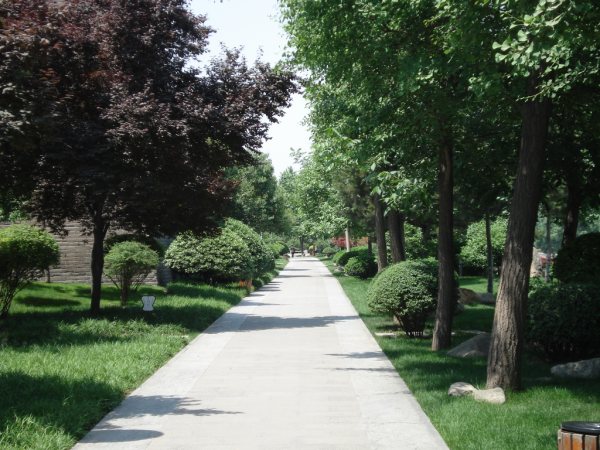
Xi'an City Wall Park
Last weekend I spent four hours walking right round the park that goes all along the outside of the City Wall. With the sky being more blue than grey for a change, I took my camera along with me...




Company outing
Last weekend was the annual company outing. In a surprising show of democracy, we were given the choice of three destinations, with the unanimous winner being a trip to Hanzhong, a small city of a million or so inhabitants that's in this province but south of the Qinling mountain range.
The morning coach trip started reasonably enough before the tour guide cranked into life. Tour guides tend to be attractive young women, but we were presented with a short fat man who was nevertheless equally annoying. Being the tallest person on the bus, and also the whitest, meant my decision to bring my MP3 was a correct one. He started playing a game where everyone had to say an adjective, then go round again and this time everyone had to say ‘My bum is…’ in front of their chosen adjective. I had my headphones on and pretended not to hear, saving myself a lot of unnecessary hassle, nomination for song singing and so on.
The Qinling mountains run across the lower half of Shaanxi Province and form a natural and formidable barrier between northern and southern China. They're the source of countless Chinese folk stories and home to an abundance of wildlife, most notably pandas. Newly built tunnels bore straight through the mountains, occasionally bursting out into sunlight to reveal the green-covered peaks before diving straight back inside.
Eventually we made it to Hanzhong. The city itself was as faceless and ordinary looking as most mid- to small-size Chinese cities. Lunch was taken in a restaurant where the food was served within one minute of our arrival, and after 15 minutes we were already being herded out. There was a wedding party going on, with large amounts of baijiu being consumed, and it looked rather more fun than our dry tables.
For the afternoon outing we went to the countryside to Wuhou Ci, or Temple of Marquis, a place commemorating the life of Zhuge Liang. Zhuge Liang was the Chancellor of Shu Han during the Three Kingdoms period 2,000 years ago, and remains a popular figure today on account of his all-round genius and wisdom. Romance Of The Three Kingdoms, one of the four great works of ancient Chinese literature, was written 1,000 years after his death and extols his exploits. As well as having contributed many of the genius ploys to the 36 Strategems, he is also credited with inventing military weapons, landmines and steamed buns.
There are actually lots of different Wuhou Ci around China, but the one here is the earliest, first built in 263AD, and continually repaired and modernised since. I found it much more pleasant and agreeable than many of the major tourist attractions in bigger cities, which are so often overrun with tourists. It was laid out in the usual way, a rectangular area laid out symmetrically around a centre line.
Inside the entrance was a small construction built to look like a city gate with a zither (ancient Chinese musical stringed instrument) inside. It commemorates the Empty City Strategem - Kong Cheng Ji 空城计 - supposedly used by Zhuge Liang. He was left stranded in a nearly deserted city with the enemy’s strong army rapidly approaching. He decided to open up the gates to the City and sit up on the Main Gate and calmly play the zither. When the enemy Sima Yi approached with his Wei army, he was suspicious and retreated, fearful of an ambush. It's now a common saying in modern Chinese meaning to use a false show of strength to cover up a weakness.
Inside was a series of neat and tidy buildings with red lacquer walls, with trees and rocks dotted in between. While the rest of our 40-strong group followed the incomprehensible guide around, I wandered off and found a secluded pond with a small pavilion in the middle with goldfish and pink lilies basking in the sun. It was here that Zhuge Liang was said to sit peacefully and mull over his tactics away from the frenzy of the battlefield – and perhaps tourists, too.
At the back of the site was a red wooden building perched high up on the wall with fantastic views over the verdant farmland and river beyond. Most people didn’t actually get to see it because they were too busy taking photographs of themselves. The sheer volume of photos taken was astonishing, with any opportunity for a photo being grasped. 'Pose' is now a word incorporated into Chinese and familiar to any young person, and ‘posing’ was the hippest thing going on. The favourite one is the classic victory V sign. There’s also the ‘pouty face with big eyes’, and leaning in front of someone else with arms outstretched. The favourite ‘pose’ of anyone older is to stand there with less expression than a Terracotta Warrior.
Later in the afternoon we went to a picturesque lake formed behind a dam. Before the dam was built in 1970, the area was the site of the remains of the earliest ancient boardwalks in China. To get from the ancient capital of Xi'an to the southern cities of Chengdu and beyond, crossing over the Qinling Mountains was the only way through, and a series of wooden boardwalks were built onto the edges of the mountains to make it possible. It took 1,900 years to complete. All that remains are a few photos in a museum.
It was a reasonably pretty area, with the lush mountain peaks rising straight out of the man-made lake, and a modern boardwalk hugging the edge, making it possible to walk a long way around in among the trees and above the water in places. Unfortunately, there was a tacky gift shop selling a cross between a recorder and an accordion, and two of the parents from our company caved in and bought one for their kids.
Evening dinner was identical to lunch, only in a different place because everyone apart from me had complained that the lunch was disgusting. It shows more my unrefined palate than my affable nature. After dinner, we were free to wander round the City. In the central square I stood with a group of old residents in battered old clothes expressionlessly watching a promotional event. There was a guy on a BMX on a stage jumping over a very frightened girl with dyed frizzy hair. The music blasting out from the speakers was that Chinese classic, Prodigy’s ‘Smack My Bitch Up’.
The second day started with a huge breakfast in the same restaurant from 12 hours previously and a short bus ride through the rain to South Lake, an extremely pretty lake dotted with small islands. It probably would have been even prettier had it not been completely shrouded in mist. The light drizzle and my lack of umbrella prompted everyone in turn to ask me how I managed without one.
Looking at the map and listening to the tour guide, it was clear we were only going to go to two of the most popular islands, a tiny fraction of the whole lake. A five-minute boat trip dropped us off at the far end of one. There was a small zoo with some bored and unimpressed looking animals hiding in the corners of their concrete boxes, and a place with monkeys where people were throwing in sweets with the wrappers left on. I wandered on up through the bamboo and over the bridge to the second island, home of the ‘Catching the Moonlight Tower’, a tall pagoda and hive of tourist activity. On seeing all the bumper cars, fairground games and general tourist pap, I wondered down to the lake edge and walked around the outside of the island, hidden among the wet green trees and away from the noise. There was a rusty old rowboat tied up with a fraying rope, and I was very tempted to hop in and propel myself into the mist to an isolated spot to enjoy the serenity that the Emperors came here for hundreds and thousands of years ago.
After about an hour or so I wandered around to the front of the pagoda, where it turned out the rest of the group were having a massive group photo on the steps leading up to the pagoda. I stayed down by the lake and watched the fish darting around under water. On the boat back, there was a frenzy of photo-taking as our brief trip away from Xi’an drew to a close.
Lunch might have been a ‘tour group meal’ we had in the same restaurant again, but it was extremely good (and free), so I stocked up. On the bus back, my friend and I amused ourselves by taking pictures of people nodding off in amusing positions. A couple of people noticed, and so were then unable (or unwilling) to get back to sleep for fear of being caught on camera. Infantile behavior rarely loses its comedy value.
This trip showed me again that China is huge and has a great number of places worth visiting away from the cities. It’s just a question of finding them and getting away from the computers, traffic jams and bad air that constitute a large part of daily urban life.


The morning coach trip started reasonably enough before the tour guide cranked into life. Tour guides tend to be attractive young women, but we were presented with a short fat man who was nevertheless equally annoying. Being the tallest person on the bus, and also the whitest, meant my decision to bring my MP3 was a correct one. He started playing a game where everyone had to say an adjective, then go round again and this time everyone had to say ‘My bum is…’ in front of their chosen adjective. I had my headphones on and pretended not to hear, saving myself a lot of unnecessary hassle, nomination for song singing and so on.
The Qinling mountains run across the lower half of Shaanxi Province and form a natural and formidable barrier between northern and southern China. They're the source of countless Chinese folk stories and home to an abundance of wildlife, most notably pandas. Newly built tunnels bore straight through the mountains, occasionally bursting out into sunlight to reveal the green-covered peaks before diving straight back inside.
Eventually we made it to Hanzhong. The city itself was as faceless and ordinary looking as most mid- to small-size Chinese cities. Lunch was taken in a restaurant where the food was served within one minute of our arrival, and after 15 minutes we were already being herded out. There was a wedding party going on, with large amounts of baijiu being consumed, and it looked rather more fun than our dry tables.
For the afternoon outing we went to the countryside to Wuhou Ci, or Temple of Marquis, a place commemorating the life of Zhuge Liang. Zhuge Liang was the Chancellor of Shu Han during the Three Kingdoms period 2,000 years ago, and remains a popular figure today on account of his all-round genius and wisdom. Romance Of The Three Kingdoms, one of the four great works of ancient Chinese literature, was written 1,000 years after his death and extols his exploits. As well as having contributed many of the genius ploys to the 36 Strategems, he is also credited with inventing military weapons, landmines and steamed buns.
There are actually lots of different Wuhou Ci around China, but the one here is the earliest, first built in 263AD, and continually repaired and modernised since. I found it much more pleasant and agreeable than many of the major tourist attractions in bigger cities, which are so often overrun with tourists. It was laid out in the usual way, a rectangular area laid out symmetrically around a centre line.
Inside the entrance was a small construction built to look like a city gate with a zither (ancient Chinese musical stringed instrument) inside. It commemorates the Empty City Strategem - Kong Cheng Ji 空城计 - supposedly used by Zhuge Liang. He was left stranded in a nearly deserted city with the enemy’s strong army rapidly approaching. He decided to open up the gates to the City and sit up on the Main Gate and calmly play the zither. When the enemy Sima Yi approached with his Wei army, he was suspicious and retreated, fearful of an ambush. It's now a common saying in modern Chinese meaning to use a false show of strength to cover up a weakness.
Inside was a series of neat and tidy buildings with red lacquer walls, with trees and rocks dotted in between. While the rest of our 40-strong group followed the incomprehensible guide around, I wandered off and found a secluded pond with a small pavilion in the middle with goldfish and pink lilies basking in the sun. It was here that Zhuge Liang was said to sit peacefully and mull over his tactics away from the frenzy of the battlefield – and perhaps tourists, too.
At the back of the site was a red wooden building perched high up on the wall with fantastic views over the verdant farmland and river beyond. Most people didn’t actually get to see it because they were too busy taking photographs of themselves. The sheer volume of photos taken was astonishing, with any opportunity for a photo being grasped. 'Pose' is now a word incorporated into Chinese and familiar to any young person, and ‘posing’ was the hippest thing going on. The favourite one is the classic victory V sign. There’s also the ‘pouty face with big eyes’, and leaning in front of someone else with arms outstretched. The favourite ‘pose’ of anyone older is to stand there with less expression than a Terracotta Warrior.
Later in the afternoon we went to a picturesque lake formed behind a dam. Before the dam was built in 1970, the area was the site of the remains of the earliest ancient boardwalks in China. To get from the ancient capital of Xi'an to the southern cities of Chengdu and beyond, crossing over the Qinling Mountains was the only way through, and a series of wooden boardwalks were built onto the edges of the mountains to make it possible. It took 1,900 years to complete. All that remains are a few photos in a museum.
It was a reasonably pretty area, with the lush mountain peaks rising straight out of the man-made lake, and a modern boardwalk hugging the edge, making it possible to walk a long way around in among the trees and above the water in places. Unfortunately, there was a tacky gift shop selling a cross between a recorder and an accordion, and two of the parents from our company caved in and bought one for their kids.
Evening dinner was identical to lunch, only in a different place because everyone apart from me had complained that the lunch was disgusting. It shows more my unrefined palate than my affable nature. After dinner, we were free to wander round the City. In the central square I stood with a group of old residents in battered old clothes expressionlessly watching a promotional event. There was a guy on a BMX on a stage jumping over a very frightened girl with dyed frizzy hair. The music blasting out from the speakers was that Chinese classic, Prodigy’s ‘Smack My Bitch Up’.
The second day started with a huge breakfast in the same restaurant from 12 hours previously and a short bus ride through the rain to South Lake, an extremely pretty lake dotted with small islands. It probably would have been even prettier had it not been completely shrouded in mist. The light drizzle and my lack of umbrella prompted everyone in turn to ask me how I managed without one.
Looking at the map and listening to the tour guide, it was clear we were only going to go to two of the most popular islands, a tiny fraction of the whole lake. A five-minute boat trip dropped us off at the far end of one. There was a small zoo with some bored and unimpressed looking animals hiding in the corners of their concrete boxes, and a place with monkeys where people were throwing in sweets with the wrappers left on. I wandered on up through the bamboo and over the bridge to the second island, home of the ‘Catching the Moonlight Tower’, a tall pagoda and hive of tourist activity. On seeing all the bumper cars, fairground games and general tourist pap, I wondered down to the lake edge and walked around the outside of the island, hidden among the wet green trees and away from the noise. There was a rusty old rowboat tied up with a fraying rope, and I was very tempted to hop in and propel myself into the mist to an isolated spot to enjoy the serenity that the Emperors came here for hundreds and thousands of years ago.
After about an hour or so I wandered around to the front of the pagoda, where it turned out the rest of the group were having a massive group photo on the steps leading up to the pagoda. I stayed down by the lake and watched the fish darting around under water. On the boat back, there was a frenzy of photo-taking as our brief trip away from Xi’an drew to a close.
Lunch might have been a ‘tour group meal’ we had in the same restaurant again, but it was extremely good (and free), so I stocked up. On the bus back, my friend and I amused ourselves by taking pictures of people nodding off in amusing positions. A couple of people noticed, and so were then unable (or unwilling) to get back to sleep for fear of being caught on camera. Infantile behavior rarely loses its comedy value.
This trip showed me again that China is huge and has a great number of places worth visiting away from the cities. It’s just a question of finding them and getting away from the computers, traffic jams and bad air that constitute a large part of daily urban life.


Sunday, 16 May 2010
Office space
Since I last wrote, our company has moved into a new office on the edge of the Hitech Zone of Xian. True to form, corners have been cut and a few pence saved. The building is miles from anywhere, and certainly not in ‘the heart of the Hitech Zone’ as mentioned on our website. The floor we’re on was originally designed for residential apartments, but they took out the walls and put some MDF ones up in different places. Unfortunately, they’ve been put right up against the windows so most of them can’t open. Most of the offices don’t even have any windows, and not being allowed to turn the lights on means those guys sit in semi-darkness in winter. The ones that do have windows are roasting hot in summer. The toilets are right in the middle of the office, so any guests coming have to walk right past them - and some translators have to sit next to them. The boss is okay though. In his huge office, he has a 60,000RMB (£6,000) table and his own living quarters.
It’s not just our company that’s into cutting corners - the developers do as well. There are only four lifts for the 23-floor building, so at midday when everyone goes for lunch, the lift is full by the twentieth floor. I usually end up taking the stairs. Mornings aren’t much better. It might seem stupid not to have enough lifts, but is actually perfectly sensible from the point of view of the developer. Why should he pay more money when he doesn’t have to? They do the bare necessities and leave. It’s the same for residential flats. When you buy a new flat in China, you’re just buying a box of concrete and steel and it’s up to you to decorate it from scratch.
Recently we’ve been doing some recruitment events in three or four universities. This year we’ve done it in conjunction with an employment website company. The woman in charge is one of those very, very short people who’s constantly trying to prove herself. She likes to announce herself as my Chinese teacher at each event. She also has a habit of saying ‘only joking’ after her appalling semi-jokes, as if telling us will remind us to laugh.
Unfortunately, our boss’s wife, Mrs S, number two in the company, is also involved and so brings with her ineptitude and stupidity at every step. We were late for the second event because she fell asleep at three in the afternoon reading the newspaper. Then she got angry and blamed us for not waking her up. During the event, when asked by the short woman to introduce the company, she went off on a 15-minute tangent about how good the company is. Asked three questions, she successfully failed to answer all three. Afterwards, when her husband - Mr Q, the main boss - phoned from abroad, she said there were over a thousand students in attendance. I love the lies. There were actually about 250 people.
In fact, we were told that there would be hundreds of students at each event. Last Saturday, there was a written exam, the first part of a series of rounds to choose 50 translators. The company originally planned for over a thousand people to turn up. The actual turnout was 136, most of whom were not in the final year of university and therefore useless to the company. On Monday we had a meeting where one of the HR guys told her about the low turnout. She was both flummoxed and angry and blamed it on everyone except herself.
I wrote and marked the exam. The final part is reading comprehension, and the last question was a general knowledge question related to the text. Last year the question was ‘Who is Saddam Hussein?’ and it offered some interesting answers - ‘President of America’, ‘a black man’, ‘a bad man’ and so on. This year the question was ‘Where is Jamaica?’. Incorrect answers included ‘Africa’, ‘UK’, ‘London’, ‘Indonesia’, and my favourite - ‘Jamaica is in the Privy Council’.
In other news, four people from an Israeli investment company came with a Chinese investment company ‘for visiting’, as it’s called. Our boss, Mr Q, actually speaks reasonable English so, as main translator, I didn’t have much to do. I think maybe the Israelis thought his waffling, avoiding the questions and general vagueness were because of his English being limited. I think it was a deliberate attempt to fend them off. Mr Q doesn’t want to make the company bigger and better, he wants to get as much money out of it as he can. Ceding control of some of it may make the company bigger and better, but that isn’t his primary goal.
On Tuesday, Mrs S called me in to her office. Apparently the email I sent on her behalf to her daughter’s school in England did the trick of getting her her visa, despite her attendance in classes being lower than UK government requirements for overseas students. She reached into her draw to get something. I thought there would be a red envelope with 100RMB in there. I should have known better. It was a packet of Indonesian coffee beans. That’s now the third unwanted present she’s given me. Her husband spent the last week entertaining government officials in Bali, and presumably one of them brought that back for her. She probably thinks all foreigners have a fancy coffee machine and eat croissants for breakfast.
Other than that, every day is just the usual proofreading technical manuals, chatting to the guy opposite me about China in the 1980s and thinking about what to do when my contract and visa run out in July. Some interesting choices ahead.
It’s not just our company that’s into cutting corners - the developers do as well. There are only four lifts for the 23-floor building, so at midday when everyone goes for lunch, the lift is full by the twentieth floor. I usually end up taking the stairs. Mornings aren’t much better. It might seem stupid not to have enough lifts, but is actually perfectly sensible from the point of view of the developer. Why should he pay more money when he doesn’t have to? They do the bare necessities and leave. It’s the same for residential flats. When you buy a new flat in China, you’re just buying a box of concrete and steel and it’s up to you to decorate it from scratch.
Recently we’ve been doing some recruitment events in three or four universities. This year we’ve done it in conjunction with an employment website company. The woman in charge is one of those very, very short people who’s constantly trying to prove herself. She likes to announce herself as my Chinese teacher at each event. She also has a habit of saying ‘only joking’ after her appalling semi-jokes, as if telling us will remind us to laugh.
Unfortunately, our boss’s wife, Mrs S, number two in the company, is also involved and so brings with her ineptitude and stupidity at every step. We were late for the second event because she fell asleep at three in the afternoon reading the newspaper. Then she got angry and blamed us for not waking her up. During the event, when asked by the short woman to introduce the company, she went off on a 15-minute tangent about how good the company is. Asked three questions, she successfully failed to answer all three. Afterwards, when her husband - Mr Q, the main boss - phoned from abroad, she said there were over a thousand students in attendance. I love the lies. There were actually about 250 people.
In fact, we were told that there would be hundreds of students at each event. Last Saturday, there was a written exam, the first part of a series of rounds to choose 50 translators. The company originally planned for over a thousand people to turn up. The actual turnout was 136, most of whom were not in the final year of university and therefore useless to the company. On Monday we had a meeting where one of the HR guys told her about the low turnout. She was both flummoxed and angry and blamed it on everyone except herself.
I wrote and marked the exam. The final part is reading comprehension, and the last question was a general knowledge question related to the text. Last year the question was ‘Who is Saddam Hussein?’ and it offered some interesting answers - ‘President of America’, ‘a black man’, ‘a bad man’ and so on. This year the question was ‘Where is Jamaica?’. Incorrect answers included ‘Africa’, ‘UK’, ‘London’, ‘Indonesia’, and my favourite - ‘Jamaica is in the Privy Council’.
In other news, four people from an Israeli investment company came with a Chinese investment company ‘for visiting’, as it’s called. Our boss, Mr Q, actually speaks reasonable English so, as main translator, I didn’t have much to do. I think maybe the Israelis thought his waffling, avoiding the questions and general vagueness were because of his English being limited. I think it was a deliberate attempt to fend them off. Mr Q doesn’t want to make the company bigger and better, he wants to get as much money out of it as he can. Ceding control of some of it may make the company bigger and better, but that isn’t his primary goal.
On Tuesday, Mrs S called me in to her office. Apparently the email I sent on her behalf to her daughter’s school in England did the trick of getting her her visa, despite her attendance in classes being lower than UK government requirements for overseas students. She reached into her draw to get something. I thought there would be a red envelope with 100RMB in there. I should have known better. It was a packet of Indonesian coffee beans. That’s now the third unwanted present she’s given me. Her husband spent the last week entertaining government officials in Bali, and presumably one of them brought that back for her. She probably thinks all foreigners have a fancy coffee machine and eat croissants for breakfast.
Other than that, every day is just the usual proofreading technical manuals, chatting to the guy opposite me about China in the 1980s and thinking about what to do when my contract and visa run out in July. Some interesting choices ahead.
Subscribe to:
Posts (Atom)

